THE KEY IDEA
Try to answer first. Then check, correct and return to the question in a later session.
What active recall means
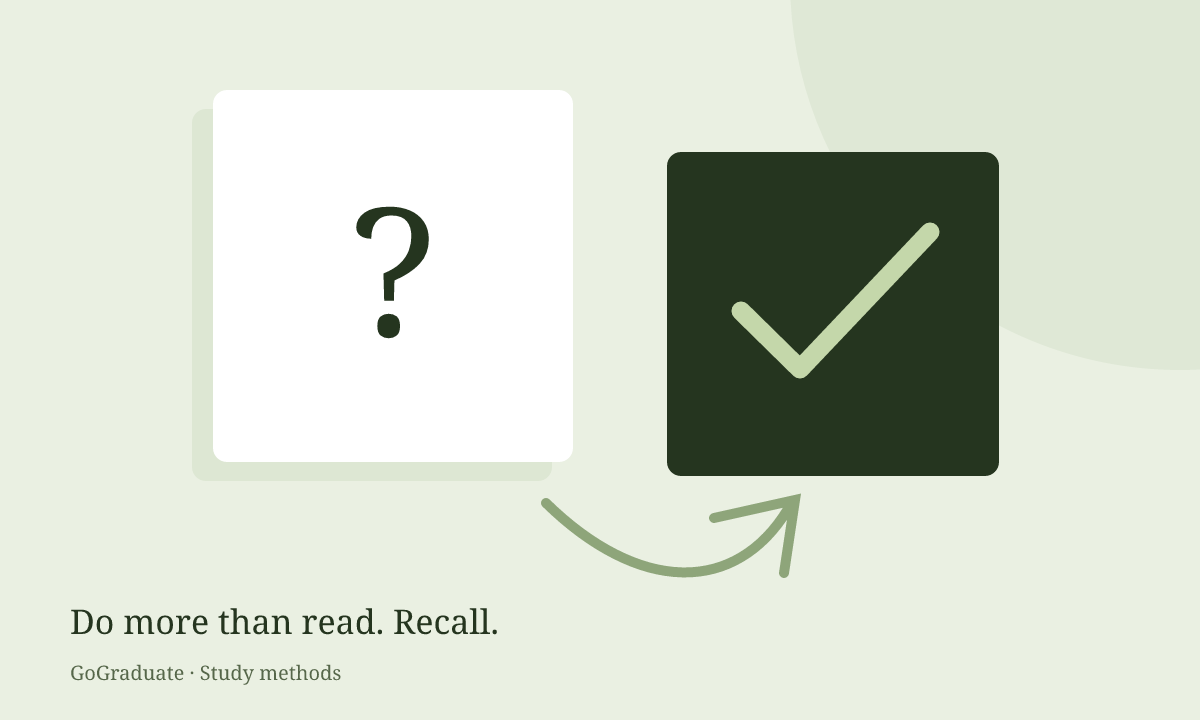
Active recall means trying to remember or use content without seeing the answer. You might explain a process, fill in an empty diagram, answer a short question or solve an exercise. You do not need flashcards or a particular app.
Rereading can introduce and clarify material. Active recall adds a check: what can you retrieve once the cues are gone? Getting stuck identifies something specific to review.
In a vocabulary experiment by Karpicke and Roediger, repeated retrieval supported later recall. That is evidence about a particular task and set of conditions, not a promise of a higher mark in every subject. The original reference is listed below.
Prepare questions that require an answer
Choose a short section and write three to five questions. Go beyond repeating its heading. Ask about a difference, a cause, a relationship or an application.
- Instead of “Industrial Revolution”, ask “Which changes explain the transition from craft production to industrial production?”
- Instead of “Text types”, ask “Which features distinguish an argument from a description?”
- After an exercise, ask “Why did I choose this approach, and when would it no longer work?”
Keep a reference answer or a passage you can use to check your response. Do not memorise a flawed question merely because it is printed on a flashcard.
Try a short session from start to finish
This twenty-minute example is one way to begin, not a universally optimal duration.
- Pick three questions. Keep the source nearby but closed.
- Answer without looking. Write a draft or explain in your own words. Mark where you are uncertain.
- Check. Open your notes and separate correct ideas, omissions and mistakes.
- Correct the specific gap. Rephrase the missing step instead of copying the whole topic.
- Arrange another attempt. Return in a later session and try without the correction in front of you.
If the original explanation is still unclear, spend time understanding it first. Remembering words does not replace understanding the relationships between them.
Adjust the challenge and record any help
If a question is inaccessible, use a small hint or split the task into parts. Afterwards, distinguish “I did it independently” from “I did it with help”. Both are useful progress, but they suggest different next steps.
Once you can answer reliably, vary the example, compare concepts or mix questions from different sections. Repeating exactly the same wording can teach you the phrase without helping you recognise the problem in another format.
There is no perfect review interval for everyone. Return to earlier questions on different days and adapt to what you remember and when the exam is due. One mistake does not mean you have forgotten everything.
Use your GoGraduate tutor to support your revision
Select your documents in the GoGraduate Tutor and ask for one question at a time: “Ask me about this section and wait for my answer.” Respond before requesting the solution. If you need help, start with a hint.
Check feedback against your notes and point out discrepancies. You can continue with practice on the difficult parts. Personalisation uses saved materials, answers and progress; it does not mean the model is retrained on you.
Finish with a short record of what you can explain and what you will try again. That turns the session into a decision about where to go next.